

The 30-Day Fall Tidy-Up for Neurodivergent Adults featuring A Gentle, Brain-Friendly Way to Reset Your Home
By Neurorganized
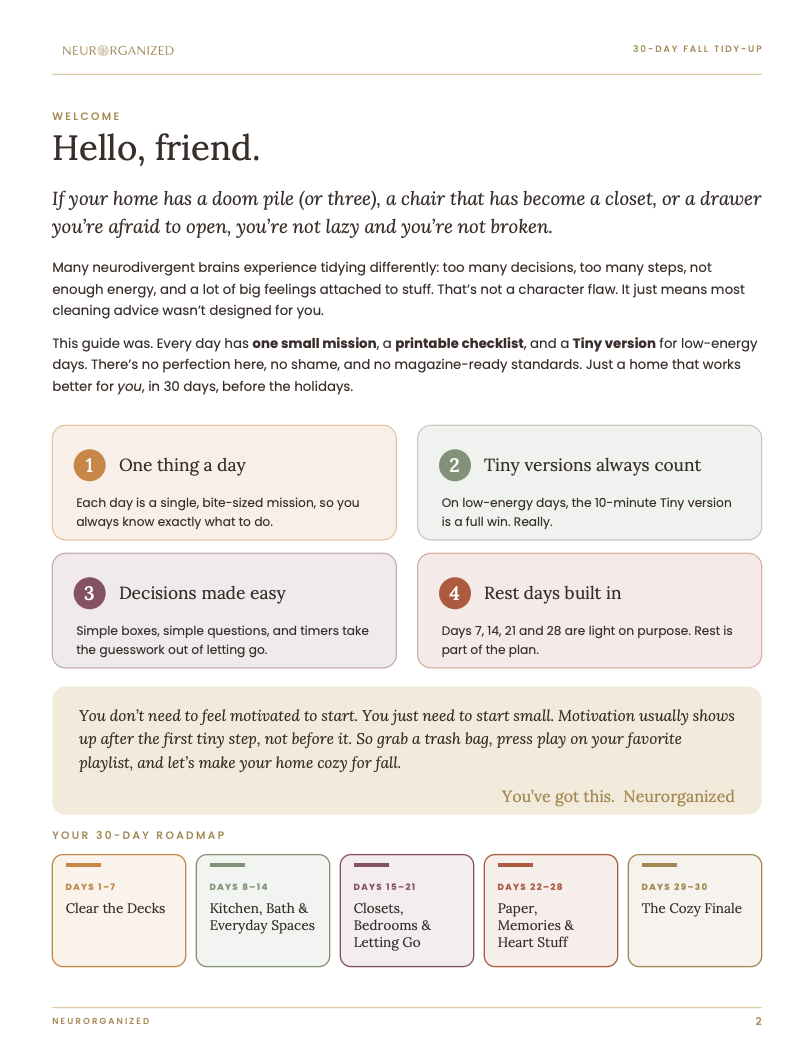
The 30-Day Fall Tidy-Up is a free printable plan that helps neurodivergent adults clear clutter one tiny mission per day.
Each day has a checklist, a 10-minute "Tiny version" for low-energy days, and a built-in celebration. Rest days, simple decision rules, and a no-catch-up policy make it work with your brain instead of against it.
Key Takeaways
Tidying is basic self-care, like brushing your teeth or getting dressed. It is not a moral test or a measure of your worth.
Most cleaning advice assumes steady energy, easy task initiation, and effortless decisions. Many neurodivergent brains work differently, so the advice breaks, not you.
Small, finishable wins build momentum, reduce shame, and make the next step easier to start.
A "Tiny version" of every task means a hard day still counts as a win.
The goal is not a perfect home. It is a calmer home and a calmer brain, so you have more room for the things you actually want to do.
Tidying Is Not a Personality Test. It's Basic Care.
If your home has a doom pile (or three), a chair that has become a closet, or a drawer you're afraid to open, you are not lazy and you are not broken.
Here is the shift we want to invite you into, and it's the heart of everything we make at Neurorganized: tidying and cleaning are not punishments, and they are not proof of your character. They are care. They sit in the same category as brushing your teeth, taking a shower, or getting dressed. Nobody expects those things to be fun every single time, and nobody calls you a failure for needing to do them again tomorrow.
So why does tidying feel so loaded?
For a lot of us, it carries years of baggage: being told to "just clean your room," feeling behind, hiding the mess before guests arrive, starting a big purge on a burst of energy and crashing halfway through. Over time, the brain learns a pattern: tidying equals stress, shame, and a never-ending cycle I can't win. Of course you dread it.
The good news is that a relationship can change. When tidying becomes small, predictable, and kind, it stops being a verdict and starts being a tool. A tool that gives you a calmer space, which gives you a calmer brain, which gives you more energy for your work, your people, your hobbies, your rest. That is the real payoff. It was never about a magazine-ready house.
And yes, it is achievable for neurospicy brains. It just needs a different design.
Why Most Cleaning Advice Fails Neurodivergent Brains
Conventional organizing advice usually looks like this: "Set aside a weekend. Pull everything out. Sort it all. Decide what sparks joy. Do it all at once, then maintain it forever."
For many ADHD, autistic, and otherwise neurodivergent adults, that plan collides with real, common challenges:
Too many decisions. Every object is a micro-decision, and the number adds up fast.
Too many steps. "Clean the kitchen" is not one task. It is thirty tasks hiding under one name, which makes starting feel impossible.
Uneven energy. Capacity changes day to day, and plans that need the same energy every day fall apart.
Big feelings attached to stuff. Objects hold memories, hopes, guilt, and identity. Letting go can be emotional, not logical.
Out of sight, out of mind. If something isn't visible, it may as well not exist, which is how piles form.
Shame spirals. Falling behind a plan feels like proof of failure, so people quit instead of restarting.
None of that is a character flaw. It means the standard advice wasn't designed for you. The 30-Day Fall Tidy-Up was.
The Psychology of Small Wins (and Why They Work So Well for Tidying)
Small wins are not a cute consolation prize. They are one of the most reliable ways to build motivation, and they fit neurodivergent brains especially well. Here is what is going on under the hood.
1. Progress fuels motivation, not the other way around
Many of us wait to feel motivated before we start. But research on work and motivation, including Harvard Business School professor Teresa Amabile's "progress principle," points the other way: making visible progress on meaningful work is one of the strongest drivers of positive feelings and further effort, even when the progress is small. Motivation often shows up after the first tiny step, not before it. That is why the plan is built around starting small, with a trash bag, a playlist, and ten minutes.
2. Finite tasks feel safer than endless ones
An open-ended job ("organize the house") has no finish line, and a brain that can't see the finish line often can't find the start line either. A visible countdown timer and a short checklist turn the job into something with edges. As we say in the guide: a visible countdown makes the task finite, and finite is less scary. When the timer rings, you are allowed to stop. Knowing you can stop is often what makes it possible to begin.
3. Tiny steps lower the barrier to starting
Task initiation, the act of getting started, is a common sticking point for many ADHD and autistic adults. Shrinking the first step until it is almost laughably easy ("pick up one cup") removes the activation hurdle. Once you are moving, continuing is usually easier than starting, which is why the plan includes a Tiny version for every single day and says plainly that it counts as a full win.
4. Checking things off gives the brain a reward signal
Many ADHD brains are described as responding strongly to immediate, visible rewards and weakly to distant ones. Coloring in a tracker circle, ticking a checkbox, or doing a one-song victory dance gives you a reward right now, instead of asking you to wait for a spotless house in a month. The "Celebrate" step on each day is not fluff. It is how the habit gets reinforced.
5. Self-compassion beats self-criticism
Shame is a poor long-term motivator. Research on self-compassion suggests that treating yourself kindly after a setback tends to support getting back on track, while harsh self-criticism tends to lead to avoidance. That is why the plan has no catch-up rule. If you miss a day, you skip it, repeat yesterday, or jump back in with today's mission. The plan bends so you don't have to break.
6. Stopping on purpose protects tomorrow
Ending while you still have a bit of energy, and on a good note, makes it far more likely you'll come back. Burning out in a three-hour purge makes the next day feel dreadful. Small, sustainable sessions build trust with yourself, and trust is what makes a routine last.
A quick note: Neurorganized shares organizing tools and general wellbeing ideas, not medical or mental health treatment. If daily tasks feel unmanageable, a doctor, therapist, or occupational therapist can offer personalized support.
How the 30-Day Fall Tidy-Up Works
The download is a printable guide of about 30 pages with checklists you can write on, a tracker you can tape to the wall, and a full plan for 30 days. Here is how it fits together.
Your daily formula
Every day follows the same five steps, so you never have to reinvent the process:
Pick your level. Tiny (10 minutes), Standard (25 minutes), or Bonus (45 minutes). Choose based on your energy today, not your guilt.
Set a timer. A visible countdown makes the task finite.
Press play. Music, a podcast, or a body-double friend on a video call. Make it fun.
Work the checklist. Go top to bottom. When the timer rings, you're allowed to stop.
Check it off and celebrate. Mark the checklist and the 30-Day Tracker, then do the celebration. It matters.
Three levels, so every day can be a win
Level | Time | What it means |
|---|---|---|
Tiny | 10 min | Just do the Tiny version. This is a full win and counts as done. |
Standard | 25 min | Work through the checklist. This is the plan for most days. |
Bonus | 45 min | Feeling it? Keep going. Stop when the energy does. |
There are also energy dots on every day (low, medium, higher), so you can glance at the week and match the mission to the energy you actually have.
Simple decision rules: the four boxes (plus one)
Decision overload is one of the biggest barriers to tidying, so every item gets just one answer:
Keep: I use it or love it, and it belongs here.
Donate: Still useful, just not for me anymore.
Trash/Recycle: Broken, expired, stained, or empty.
Relocate: Good item, wrong room. It goes to its home.
The Maybe Box: For items you truly can't decide on. Write today's date on the box and set a reminder for 30 days later. If you haven't needed anything inside, you're free to release it, with no re-opening required.
When you're stuck, four quick questions help: Do I use it? Do I love it? Would I buy it again today? Does it fit my life now?
Rest days are part of the plan
Days 7, 14, 21, and 28 are light on purpose. Rest is not something you earn after enough productivity. It is built in, along with a weekly check-in where you notice what you did, what felt hard, what helped, and how to go easy on yourself next week.
Your 30-Day Roadmap at a Glance
Days | Theme | What you'll tackle |
|---|---|---|
1–7 | Clear the Decks | Base Camp setup, a trash sweep, the paper pile, the clothes chair, a landing spot for keys and bags, flat surfaces |
8–14 | Kitchen, Bath & Everyday Spaces | Fridge and pantry, mugs and the lid graveyard, laundry, the bathroom, the living room, a quick clean kit |
15–21 | Closets, Bedrooms & Letting Go | Bedroom floor and nightstand, closet, drawers, shoes and bags, linens, a gentle letting-go warm-up |
22–28 | Paper, Memories & Heart Stuff | Paper mountain, the "someday" hobby pile, the memory box, gifts and guilt items, junk drawers, the donation run |
29–30 | The Cozy Finale | Fall cozy touches, a tiny daily routine, and a full celebration of what you did |
Notice what Week 1 says: we're not organizing yet. We're just clearing the way. The first week is about momentum, and the emotionally heavy work (sentimental items, gifts, guilt) waits until you've built some confidence.
Support for the Tender Stuff
One of the most important pages in the guide is "Letting Go With Love." For many neurodivergent adults, stuff holds feelings, memories, hopes, and parts of our identity. If letting go feels hard, nothing is wrong with you. You're just a person who cares.
The guide offers gentle tools like:
Permission slips, such as "I'm allowed to let go of gifts I don't use or like," "I can release 'someday me' stuff," and "Letting go is not forgetting."
A tiny release ritual: hold it, thank it, release it, move it out.
Alternatives when you can't decide: photograph it, Maybe Box it with a date, or ask a trusted friend to hold it while you decide.
There is also a one-page "Feeling Stuck? Try This" guide with eight quick resets, including body doubling, changing the vibe, fueling up, and naming the tiniest possible next step.
Keep It Going After Day 30
The goal isn't a perfect home. It's a home that doesn't take much to maintain. After the 30 days, the guide gives you three tiny routines to keep doom piles from growing back: a 10-minute Daily Reset, a 30-minute Weekly Reset, and a 45-minute Monthly Reset, plus a Daily Reset tracker and a "doom pile early warning" rule (if a pile gets bigger than a laundry basket, set a 10-minute timer and sort it into your four boxes).
How to Start Today (Even If You're Tired)
You don't need to feel motivated. You just need to start small.
Download and print the guide (or keep it on your tablet).
Gather your Base Camp supplies: trash bags, sticky notes, donation bags, a timer, a laundry basket, and a playlist.
Take three "before" photos of your messiest spots. Don't judge them. They're proof you'll be glad to have later.
Write your "why" on the tracker and pick a reward for the end of Week 1.
Start with Day 1, or just do the Tiny version of whatever day you're on.
Pro tip: if starting on a Monday feels like too much pressure, start tonight. Any day is Day 1.
From Dread to Joy: Shifting Your Relationship With Tidying
Here is the deeper work underneath the checklists. You can practice small reframes every time you pick up a trash bag:
"I have to clean" becomes "I'm making space for what I love." The point of a calmer room is the evening you get to enjoy in it.
"I'm so behind" becomes "I'm starting where I am." Every circle on the tracker counts the same, even the tiny ones.
"A clean house proves I'm okay" becomes "A tended space supports me." You wouldn't call yourself a failure for being hungry again after lunch. Needing to tidy again is the same: ordinary maintenance, not a verdict.
"I should do it the right way" becomes "If it works for me, it's the right way." Clean baskets of unfolded laundry count. Done is better than folded.
"Tidying steals my time" becomes "Tidying buys my time." Less hunting for keys, fewer visual distractions, and an easier time getting started on the things that matter to you.
Pair the work with joy on purpose. Light a candle, put on your favorite playlist, call a friend and body-double, wear your cozy socks. When tidying is paired with comfort, your brain starts to associate it with safety instead of dread.
Frequently Asked Questions
What is the 30-Day Fall Tidy-Up?
It's a free, printable, 30-day decluttering and organizing plan designed for neurodivergent adults. Each day has one small mission, a printable checklist, a Tiny version for low-energy days, a brain-friendly tip, and a celebration.
Is this plan only for people with ADHD?
No. It's written with neurodivergent adults in mind, including people with ADHD, autism, and other differences in executive function, sensory needs, or energy. Anyone who feels overwhelmed by standard cleaning advice can use it.
How much time does it take each day?
Choose your level: Tiny is about 10 minutes, Standard is about 25 minutes, and Bonus is about 45 minutes. Rest days (7, 14, 21, and 28) are around 10 minutes.
What if I miss a day, or several?
That's fine. Don't try to catch up. Skip it, repeat yesterday, or jump back in with today's mission. The plan is designed to bend so you don't have to break.
Do I have to do it in order?
It works best in order, because the first week builds momentum before the emotional work in Week 4. But if you need to adapt it, go ahead. If it works for you, it's the right way.
What if I get stuck deciding what to keep?
Use the four boxes (Keep, Donate, Trash/Recycle, Relocate) and the Maybe Box. Put the item in the Maybe Box with today's date and revisit in 30 days. If you haven't needed it, you can release it.
What is body doubling, and does it help with tidying?
Body doubling means working alongside another person, in the room, on a call, or on video chat, while each of you does your own task. Many ADHD and neurodivergent adults find it makes starting and continuing easier. You can use it on any day of the plan.
Can I use this plan in other seasons?
Yes. The daily formula, the four boxes, and the Tiny versions work any time of year. The Fall edition adds cozy seasonal touches and is timed to help you reset before the holidays.
Ready to Start? Grab the Free Download
If you're ready to trade dread for a gentler, more joyful way to care for your home, download The 30-Day Fall Tidy-Up below. Print it, tape the tracker where you'll see it, and start with just one tiny step.
Download your free 30-Day Fall Tidy-Up here
Progress over perfection. Always.
