
Task Paralysis is Why You Feel Stuck and Small Wins Can Help You Move Forward Again
Part 1: Understanding Task Paralysis & Why We Freeze
There are moments when life feels less like a to-do list and more like standing in front of a mountain with no visible trail.
You know things need attention. The dishes are piling up. Emails are unanswered. Laundry sits untouched. Maybe there are bigger responsibilities painfully waiting in the background like the business idea you care deeply about, paperwork you keep avoiding, health goals you promised yourself you would return to, or the overwhelming mental clutter of simply trying to keep life functioning.
The frustrating part is that you want to do the thing.
You care, and you think about it constantly. You may even feel guilty about not starting. And yet, somehow, you remain frozen.
Instead of taking action, you scroll. You stare at the mess. You mentally rehearse everything you need to do without actually beginning. Hours pass, sometimes days, and the shame begins quietly building in the background.
If this sounds familiar, there is something important you deserve to hear...task paralysis is not laziness.
It is not a character flaw, a lack of discipline, or proof that you are incapable.
Generally speaking, task paralysis is what happens when your brain and nervous system become overloaded beyond their current capacity to organize, prioritize, and initiate action. For many people, especially those navigating neurodivergence, burnout, chronic stress, anxiety, or perfectionism, task paralysis is not a motivation problem.
It is an overwhelm problem.
What Is Task Paralysis?
Task paralysis refers to a state when a person feels mentally or emotionally “stuck” and unable to begin, continue, or complete tasks despite wanting to.
You may hear similar terms used in psychology and neuroscience, particularly executive dysfunction, which refers to difficulties with the cognitive skills responsible for planning, prioritizing, organizing, initiating action, regulating attention, and following through on tasks. These mental processes are frequently called executive functions, and they act like the brain’s internal management system.
When executive functioning is strong, tasks feel manageable. You can break down steps, estimate time, shift priorities, and begin without excessive internal resistance. When executive functioning becomes overloaded, however, even seemingly simple tasks can begin to feel impossibly large.
This is why someone can successfully manage a demanding career but suddenly feel incapable of unloading the dishwasher. It is why an intelligent, capable person may avoid answering one email for days despite thinking about it constantly.
From the outside, it may look irrational.
From the inside, it feels exhausting.
Task paralysis commonly shows up in people navigating:
ADHD and executive dysfunction
Autism and sensory overwhelm
AuDHD
Anxiety
Depression
Burnout
Chronic stress
Perfectionism
Major life transitions
Caregiver fatigue
Emotional exhaustion
At its core, task paralysis generally occurs when the brain perceives the demand in front of it as larger than the resources currently available to handle it.
The struggle is frequently found in the relationship between the task and your current mental, emotional, physical, and nervous system capacity.
Why Your Brain Freezes Instead of Starts
One of the most misunderstood parts of overwhelm is the assumption that stress should make us more productive. Many of us grow up believing that pressure creates performance. That if something matters enough, we should simply push harder.
But human brains do not always work that way.
When demands exceed capacity, the nervous system often shifts into protective responses. You have probably heard of fight or flight, but there are other nervous system responses such as freeze and shutdown.
Task paralysis consistently lives somewhere inside those latter experiences.
Instead of mobilizing energy toward action, the brain essentially hits pause. The task begins to feel emotionally heavy. Decision-making becomes harder. Prioritizing feels impossible. Even thinking about where to start can feel draining. This is not because you are incapable. It is because overwhelm changes how the brain allocates resources.
When stress increases, the brain becomes more focused on managing perceived threat than long-term planning, although the threat is not danger in the traditional sense.
The “threat” may look like:
too many unfinished responsibilities
emotional exhaustion
fear of failure
uncertainty
shame
perfectionism
overstimulation
invisible mental labor
not knowing where to start
In these moments, the brain is not necessarily asking:
-Can I do this?
Instead, it is asking:
-Do I have enough energy, clarity, and safety to manage this right now?
If the answer feels uncertain, many people freeze.
The Hidden Weight of Invisible Tasks
One reason task paralysis feels so confusing is because many tasks are not actually as simple as they appear. Take something like “clean the kitchen.” On paper, it sounds like one task.
In reality, your brain may interpret that request as:
unload dishwasher
reload dishwasher
throw away expired food
wipe counters
clean stove
organize mail pile
decide what to do with random clutter
sweep
remember cleaning supplies
decide what matters most
estimate time
tolerate sensory discomfort
resist distraction
What looked like one task suddenly becomes dozens of invisible decisions.
This is known as cognitive load, or the amount of mental effort required to process information and complete activities. For overwhelmed brains, especially neurodivergent brains, high cognitive load can become incredibly draining. The exhaustion begins before the task even starts. When cognitive load becomes too high, many people unconsciously avoid the task altogether feeling the task is too expensive right now.
Why “Just Start” Advice Repeatedly Falls Flat
If you have ever been told to “just start,” chances are it did not feel particularly helpful.
While well-intentioned, productivity advice consistently assumes that everyone has equal access to mental energy, executive functioning, emotional bandwidth, and nervous system regulation. But they do not.
Telling an overwhelmed person to “just start” can feel similar to telling someone who is mentally overloaded to simply “try harder.” The problem is not effort. Many people stuck in task paralysis are already exerting enormous mental effort simply trying to function.
They are thinking about responsibilities constantly. Carrying guilt. Mentally rehearsing what needs to happen. Feeling shame about not doing enough. That invisible emotional labor is exhausting.
In fact, one of the cruelest parts of task paralysis is that it repeatedly makes people believe they are failing while quietly ignoring how hard their brain is already working behind the scenes. Unfortunately, shame rarely creates sustainable momentum. It increases overwhelm...or worse, shame.
Now it is no longer:
-I need to do laundry.
It becomes:
-Why can’t I just get myself together?
That emotional mental weight matters more than many people realize. Navigating task paralysis is rarely about becoming more disciplined. We're understanding now that it is about becoming more supported.
The first step toward momentum is shifting from:
-How do I force myself to do more?
To this instead:
-What is making this feel so hard right now?
Part 2: Why Small Wins Matter More Than Motivation
If task paralysis frequently begins with overwhelm, the next question becomes:
How do we actually move again?
Most people assume the answer is motivation. They wait to feel ready. Productive. Energized. Focused. Inspired. Unfortunately, motivation is unreliable, especially when you are mentally exhausted, emotionally overwhelmed, burned out, or navigating executive dysfunction.
In fact, many people stuck in task paralysis fall into an invisible waiting pattern:
I’ll do it when I feel more motivated.
But days pass. Energy fluctuates. Life continues happening. And responsibilities quietly grow heavier in the background. The difficult truth is that motivation is the result of momentum, not the prerequisite for it.
This can feel deeply frustrating when you are already struggling because it seems backwards. If you are overwhelmed, how are you supposed to create momentum without motivation first? The answer begins much smaller than most productivity advice would have you believe.
The Psychology of Small Wins
One of the most important shifts in overcoming task paralysis is understanding the psychology behind small wins.
Small wins may seem insignificant on the surface. Answering one email. Throwing away expired food. Folding a single basket of laundry. Cleaning one counter instead of the entire kitchen.
When you are overwhelmed, these actions can feel “too small to count.” However, psychologically, they offer more relief than realized. Research in behavioral psychology suggests that progress itself helps create emotional momentum. Small completed actions signal to the brain:
Something moved forward.
That signal is the spark to the flame of momentum. Every completed task, even a small one, creates evidence that movement is possible.
Instead of reinforcing:
- I can’t do this.
The brain begins collecting proof of:
- I started.
That shift seems subtle, but it can be incredibly powerful. Task paralysis is not always solved by accomplishing everything. It is overcome by helping the nervous system believe:
We are safe enough to begin.
Beginning becomes easier when expectations become smaller.
Why Big Goals Can Backfire During Overwhelm
Many of us unknowingly make task paralysis worse because we try to solve overwhelm with larger expectations.
We create long productivity lists.
We tell ourselves:
-Today, I’m finally getting my life together.
We expect ourselves to clean the whole house, answer every email, organize the garage, meal prep, exercise, finally tackle the project we have been avoiding, and somehow feel emotionally regulated by dinner. The problem here is not ambition. The problem is scale.
When the brain already feels overloaded, large expectations can accidentally intensify nervous system resistance. This happens because the brain interprets giant tasks as high-cost demands. The bigger and more emotionally loaded the task feels, the harder initiation becomes.
Suddenly, something like "Organize the bedroom" does not feel manageable, it feels endless. Overwhelmed brains typically struggle most with unclear finish lines. Tasks without clear boundaries feel emotionally expensive.
Compare these two approaches:
Version One:
Clean the house.
Version Two:
Throw away trash in one room.
One feels infinite, the other feels survivable.
When survival mode is active, survivable matters. This is not lowering standards forever. This is learning how to work with your current capacity instead of fighting against it.
Understanding Productivity Capacity
One of the most overlooked reasons people struggle with task paralysis is that they unknowingly expect the same version of themselves every day.
However, human beings are not machines. Your energy fluctuates. Your focus fluctuates. Your emotional regulation fluctuates. Your sensory tolerance fluctuates.
Your cognitive bandwidth changes based on sleep, stress, hormones, burnout, overstimulation, relationships, physical health, responsibilities, grief, and even environmental demands. Some days, you genuinely have the bandwidth to deep clean your home, work through your inbox, and finish projects. Other days, brushing your teeth feels difficult.
Neither experience makes you lazy. They simply reflect different levels of available capacity. This is particularly important for neurodivergent people, burnout recovery, and highly overwhelmed individuals. Many people silently compare themselves to an unrealistic internal expectation:
- I should be able to function at 100% all the time.
Sustainable productivity rarely works that way. Instead, it can be more helpful to ask:
- What is realistic for the version of me that exists today?
Supportive productivity does not ask:
- What should I accomplish?
It asks:
- What is actually possible right now?
Those are not the same question, and the answer deserves more compassion than criticism.
Learning Your Unique Productivity Flow
One of the hardest things about productivity advice is that it tends to assume everyone works the same way. Different nervous systems need different forms of support.
Some people focus best in short, high-energy bursts. Others need slow, gentle momentum. Some work best in silence. Others focus better with background noise, movement, or music. Some people need visual systems. Others need voice notes, timers, body doubling, accountability, or external structure. Some people have predictable energy. Others move through fluctuating cycles of focus and fatigue. There is no morally superior productivity style.
There is only the question:
- What helps my brain feel supported enough to move?
For some people, momentum begins with five minutes. For others, it starts with reducing sensory overwhelm. For others, it looks like lowering expectations enough to make the task feel approachable again.
The goal is not becoming someone else. The goal is learning how your nervous system works best. When we stop forcing ourselves into systems that were never designed for us, productivity can begin feeling less like punishment and more like partnership.
Part 3: Permission for “Enough,” Finding Quick Relief, and Moving Forward Gently
One of the most difficult parts of task paralysis is that the struggle rarely ends with the task itself. Eventually, something else enters the room...guilt.
For many people, guilt quietly becomes the loudest voice in the background. Guilt for what was not done. Guilt for needing rest. Guilt for not functioning the way you think you “should.” Guilt for feeling overwhelmed by responsibilities that other people seem to handle effortlessly. Over time, this can create a painful internal cycle.
You feel overwhelmed, so starting becomes harder. Because starting feels harder, tasks pile up. As tasks pile up, shame increases. As shame increases, the emotional weight of beginning grows heavier.
Eventually, even simple responsibilities begin carrying emotional baggage. The laundry is no longer just laundry. The email is no longer just an email. The messy room becomes evidence that you are behind. The unfinished project becomes evidence that you are failing.
Unexpectedly, in the middle of all of this, productivity becomes tied to self-worth.
If you have ever found yourself thinking:
- Why can’t I just get it together?
You may be asking yourself the wrong question. Navigating task paralysis is less about forcing yourself to function harder and more about learning how to respond to overwhelm differently. So, the question to finding relief should become:
- What kind of support does my nervous system actually need right now?
The Hidden Cost of “Never Enough”
Many overwhelmed people unknowingly live with an invisible rule:
Whatever I do is never enough.
You finish one task, but immediately focus on the ten unfinished ones. You clean part of the house but criticize yourself for not finishing all of it. You answer three emails but still feel behind. You rest, but feel guilty while resting.
This mindset can be particularly common among high achievers, caregivers, people navigating burnout, and many neurodivergent individuals who have spent years feeling misunderstood or trying to “catch up.”
Somewhere along the way, many people internalize the belief that productivity equals value. That resting must be earned. That slowing down means failure. That unfinished tasks mean something is wrong with them.
Trying to force 100% productivity from a nervous system already running on 20% capacity generally creates deeper exhaustion, not more progress.
Why Quick Relief Matters More Than Perfect Productivity
When people are overwhelmed, they assume they need to tackle the biggest, hardest task first. Psychologically, this can sometimes backfire.
Remember what we discussed earlier about behavioral momentum, that movement creates movement? When the nervous system feels overloaded, progress becomes easier when we begin with what offers quick relief.
Quick relief tasks are not about avoidance. They are about reducing emotional pressure. One small action can meaningfully reduce the background noise your brain has been carrying.
Examples might include:
throwing away visible trash
responding to one stressful message
clearing one counter
scheduling the appointment you keep avoiding
opening the mail pile
placing laundry into baskets instead of folding it
moving dishes to the sink
writing down swirling thoughts
These tasks seem small but psychologically they reduce mental friction.
They tell the brain:
- Something shifted.
A Gentle Way to Find Momentum Again
When task paralysis feels especially heavy, it can be difficult to know where to start. This is where people get stuck, because everything feels equally urgent. Everything feels heavy. Everything feels emotionally loud.
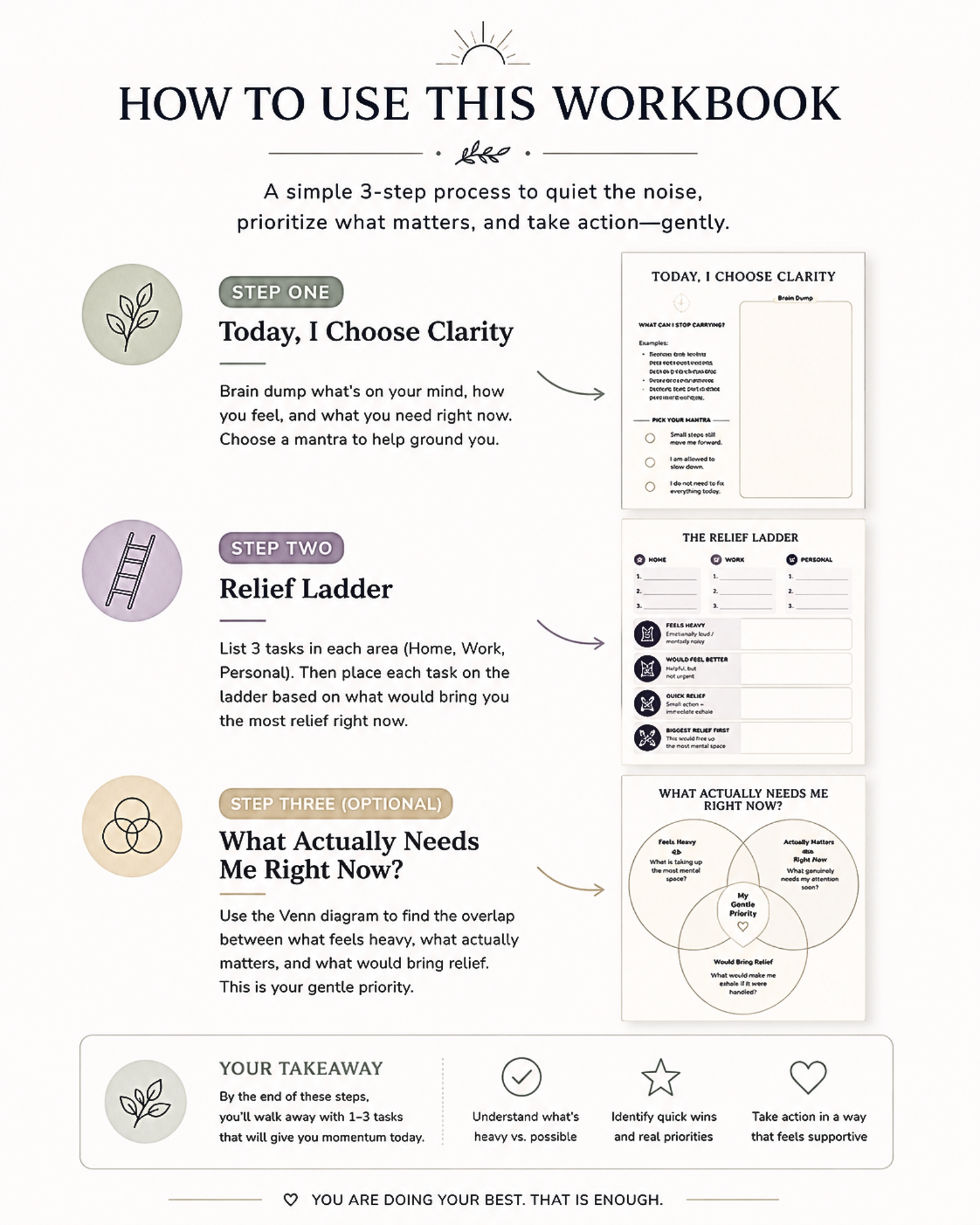
That is one reason the Gentle Reset Workbook was created.
Not to pressure you into perfect productivity, or turn healing into another impossible checklist, but to help overwhelmed brains slow down enough to sort through the mental noise.
Instead of asking:
- How do I do everything?
The workbook gently shifts the question toward:
- What would bring relief first?
Through guided reflection, prioritization, and emotional check-ins, it is designed to help you identify:
what feels emotionally heavy
what can realistically wait
what offers quick relief
what feels manageable with your current energy
what is actually possible today
Clarity matters, and overwhelmed brains struggle most when everything feels equally important. You have permission to stop 'spiraling', and to start smaller.
You have permission to acknowledge:
I cannot do everything right now, but I can do something.
Research to Explore Further
If you are interested in the psychology of progress and motivation, research by Teresa Amabile and Steven Kramer on The Progress Principle explores how small wins significantly impact motivation, emotional regulation, and long-term momentum. Their work highlights how even modest progress can improve emotional well-being and performance over time, reinforcing the importance of small, meaningful steps during periods of overwhelm.
