
Understanding the Dopamine Chaser NeuroType and How To Gain Momentum
The Dopamine Chaser NeuroType
“Why can I do impossible things under pressure… but struggle with the dishes?”
If you’ve ever found yourself deep-cleaning the entire house at 11 PM because suddenly your brain decided now is the time, welcome. If you’ve ever stared at a simple task for three days, only to finish it in twenty minutes fueled by panic and caffeine, I see you.
If people have called you “inconsistent,” “lazy,” “scattered,” or told you that you “just need discipline,” there’s a good chance you’re not lacking motivation at all.
You may simply be a Dopamine Chaser.
And before we go any further, I need you to hear this:
❌ You are not broken.
Your brain responds differently to motivation, stimulation, and momentum. Once you understand why, life starts making more sense.
What Is a Dopamine Chaser?
At your core, a Dopamine Chaser thrives on interest, novelty, urgency, momentum, and emotional connection.
💡 Your brain lights up when something feels:
exciting
meaningful
emotionally relevant
new
challenging
urgent
You are often brilliant in high-pressure situations.
The irony here is that you may look incredibly capable to other people while privately struggling to do the most ordinary things. You can research something for six straight hours. You hyper-focus on a passion project. You help everyone else organize their lives.
But when it comes to doing important tasks for yourself, or for basic responsibilities...suddenly your brain says: “Absolutely not.”
And it feels confusing, because logically, you know the task matters. But motivation doesn’t arrive simply because something is important. For a Dopamine Chaser, motivation tends to arrive when something feels stimulating enough to activate momentum.
That distinction changes everything.
The Science Behind It (In Simple Terms)
Let’s make this feel less mysterious.
Many neurodivergent brains, particularly those with ADHD traits or ADHD overlap, process dopamine regulation differently. Dopamine isn’t just the “happy chemical.”
It plays a major role in:
motivation
reward processing
attention
task initiation
momentum
interest-based focus
This means your brain often responds less to:
“I should do this.”
And far more to:
“This feels interesting.”
“Oh no, the deadline is tomorrow.”
“I finally feel the energy to tackle this.”
That’s why traditional productivity advice can feel impossible with rigid schedules, long repetitive systems, or doing things simply because they’re “responsible.”
Those systems were often built by brains that gain momentum through predictability. Yours most likely gains momentum through activation. Once that activation happens, you can move mountains.
The Hidden Strengths of a Dopamine Chaser
Here’s where I want to gently challenge the narrative you may have been told about yourself. While this NeuroType can absolutely feel frustrating, it also comes with incredible strengths.
You are deeply curious.
You probably learn quickly when something captures your attention, connect ideas rapidly, and notice possibilities others miss.
Your brain often moves fast, creatively, and laterally.
You are the person who says:
“Wait…what if we tried this instead?”
Thinking outside of the box when you're truly inspired is where your zone of genius thrives. However, using that natural problem solver brain of your can sometimes burn up a generous amount of energy.
You can perform exceptionally under pressure.
Now, would I recommend surviving exclusively on stress hormones? No.
But many Dopamine Chasers become incredibly resourceful when urgency kicks in. You adapt, problem solve, move quickly, and think on your feet. This is why so many neurodivergent adults secretly become amazing in crisis management, entrepreneurship, creative industries, caregiving, or fast-paced environments (despite the risk of burnout). Your brain often works best when movement already exists.
You bring energy and innovation.
You crave growth, exploration, and newness. You are often the person introducing fresh ideas, experimenting, pivoting, or reinventing systems that stopped working. Traditional systems can feel restrictive because your brain naturally asks:
“Could there be a better way?”
That curiosity is powerful, and necessary for our society to continue innovating.
Common Struggles of a Dopamine Chaser
Now let’s talk about the part nobody explains, because understanding the hard parts helps remove shame.
1. “Why do I wait until the last minute?”
Your brain may simply struggle with task initiation without stimulation. Sometimes urgency becomes the stimulation. The pressure creates enough activation to begin.
This often looks like:
procrastination followed by over-performance (and burnout)
deadline panic cycles
“all or nothing” productivity
exhaustion after hyper-focus
You might be convinced that you perform better under pressure, but over time, living in emergency mode gets exhausting.
2. Routine can feel painfully boring.
You may love organization in theory, but maintaining the same routine every day is where things fall apart. Your brain often craves novelty mixed with structure.
Too much freedom creates chaos, and too much rigidity creates resistance.
This is why many Dopamine Chasers constantly abandon planners, routines, or systems.
Not because they don’t care, but because the system stopped stimulating the brain.
3. Time feels… weird.
You may:
underestimate how long things take
lose hours hyper-focused
forget tasks exist
suddenly realize an entire afternoon disappeared
This isn’t a moral failure. Many neurodivergent brains struggle with time awareness and future task visibility. If you can’t “see” something, it can disappear mentally.
Out of sight often means out of working memory.
4. Motivation feels inconsistent.
This one hurts, because it often makes you question yourself or your capabilities.
You may think:
“Why was I able to do so much yesterday and nothing today?”
The truth is your energy, stimulation, cognitive bandwidth, sleep, stress, and nervous system all influence task activation. You are not a robot, and your capacity changes. Understanding this helps you stop fighting yourself.
What Actually Works for a Dopamine Chaser
Here’s where we stop trying to force your brain into systems that don’t fit.
The goal is not perfection, the goal is reduced friction. We want to work with your nervous system. Not against it.
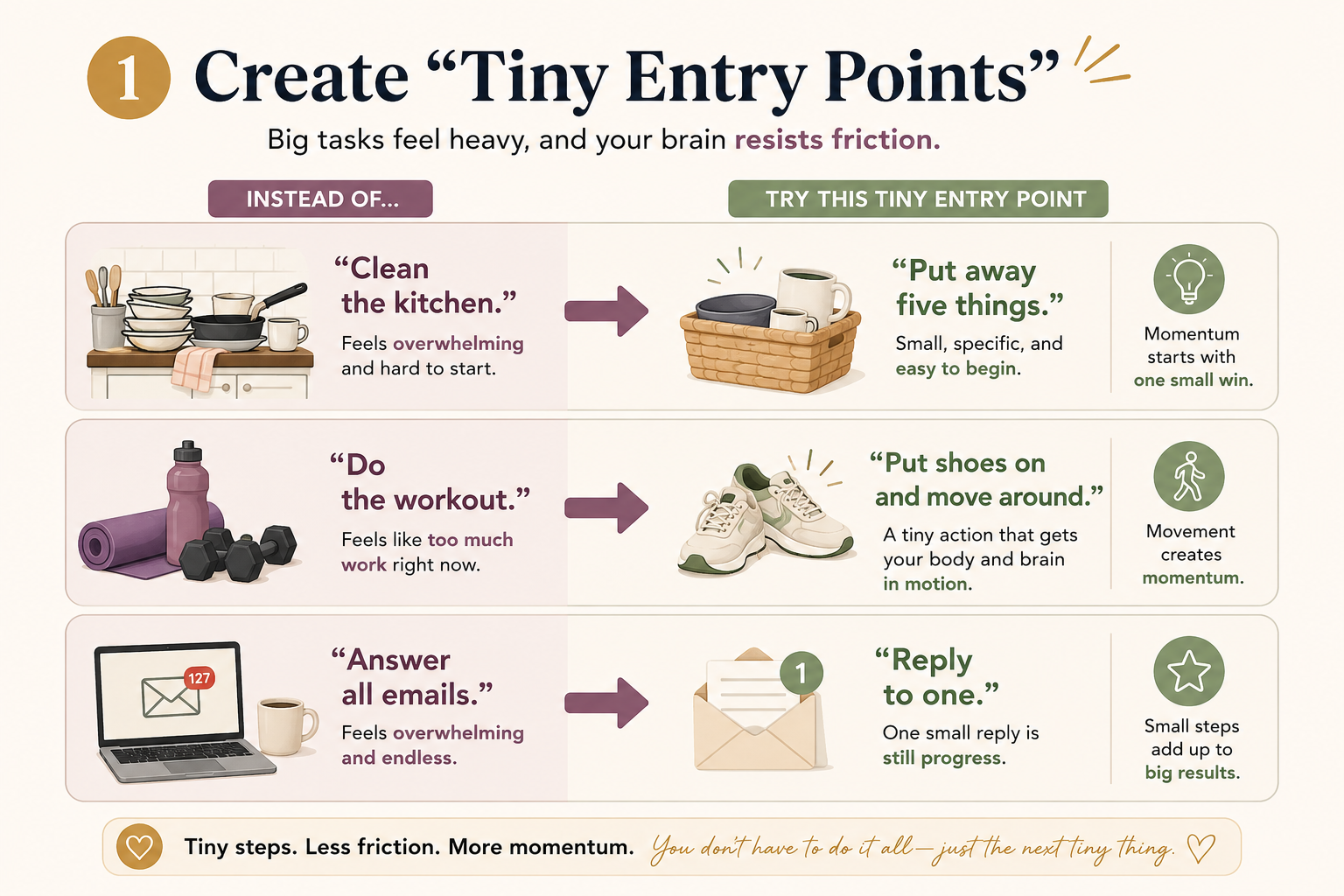
1. Create “Tiny Entry Points”
Big tasks feel heavy, and your brain resists friction.
So instead of: “Clean the kitchen.” ➡️ “Put away five things.”
Instead of: “Do the workout.” ➡️ “Put shoes on and move around.”
Instead of: “Answer all emails.” ➡️ “Reply to one.”
Momentum matters more than motivation. Once movement begins, your brain often naturally continues. We are reducing resistance, not forcing discipline.
2. Use Novelty on Purpose
You are allowed to make boring things more interesting...seriously.
Rotate:
playlists
cleaning routines
work locations
aesthetics
timers
rewards
planning tools
Use color, sticky notes, new supplies, body doubling, and gamification.
You do not need to organize like someone else, you need systems your brain will actually return to.
3. Build “Flexible Structure”
Rigid schedules often fail Dopamine Chasers. Use priority anchors instead of time-blocking your day.
Instead of: 8:00 AM — exact task
Try:
Today’s 3 Wins
One necessary task
One easy win
One future-you favor
This creates flexibility without overwhelm, but you still have direction, with less pressure.
4. Use Visual Reminders Everywhere
If it disappears from sight, it may disappear mentally, and that’s okay. External support matters.
Try:
visible baskets
open storage
whiteboards
visual calendars
sticky notes
phone widgets
habit trackers
alarms with specific labels
Instead of: “Doctor appointment.”
Try: “Leave in 20 min for appointment.”
Reduce thinking, and increase visibility.
5. Stop Depending on Motivation
This one changed my life. Motivation is unreliable, but momentum is trustworthy. You do not need to feel motivated first. You need a starting ritual that's tiny, predictable, and low effort.
Examples:
coffee or tea before work
one song before cleaning
setting a warm up timer for 10 minutes
opening the laptop only
standing in the room first
Small actions teach your nervous system "we're beginning now", like priming a machine before starting it up, or warming up before a workout routine.
What a Dopamine Chaser Needs to Hear
You are not lazy. You are not dramatic. You are not failing at adulthood.
You are navigating life in a brain that often runs on interest-based activation instead of obligation-based activation. That can feel hard in a world built around consistency. But your brain also brings creativity, adaptability, passion, curiosity, and big-picture thinking. The goal is not becoming someone else. The goal is building systems that finally feel like they were designed for you. When a Dopamine Chaser stops fighting their wiring, that’s when life starts feeling lighter.
For the first time, you stop asking: “What’s wrong with me?”
And start asking: “What actually works for me?”
Recommended Products
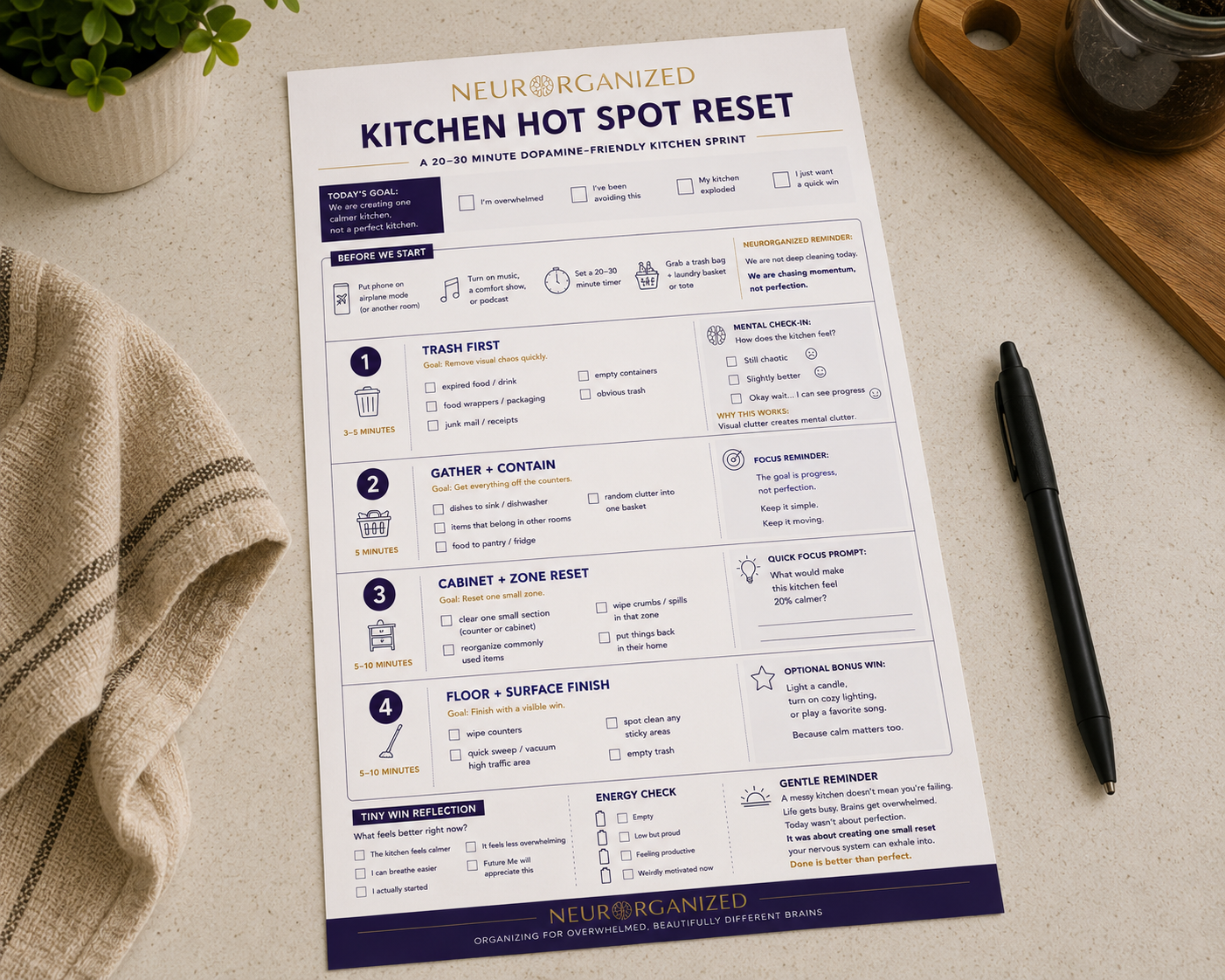
If you're looking for practical ways to improve your life and find that special activation point, I recommend looking into products like our "Hot Spot" Home reset, or Vision Board Book Collection. The "Hot Spot" templates are designed for quick wins without heavy lifting, and the Vision Board Book collection allows space for monthly check-ins instead of daily or weekly.
Want To Learn the Science Behind This?
The Dopamine Chaser NeuroType is informed by research surrounding dopamine regulation, executive functioning, motivation, and interest-based nervous system activation, particularly within neurodivergent populations and ADHD-related studies.
Recommended Readings:
Barkley, R. A. (2015). Attention-Deficit Hyperactivity Disorder: A Handbook for Diagnosis and Treatment (4th ed.). New York: Guilford Press.
This resource explores the neuroscience behind motivation, executive functioning, task initiation, reward processing, and why many neurodivergent individuals struggle with consistency despite strong capability.
📘 For those interested in the neuroscience of motivation and dopamine:
Volkow, N. D., Wang, G. J., Tomasi, D., & Baler, R. D. (2011). Motivation Deficit in ADHD Is Associated with Dysfunction of the Dopamine Reward Pathway. Molecular Psychiatry, 16(11), 1147–1154.
This research explores how dopamine pathways influence motivation, reward sensitivity, and task activation, helping explain why urgency, novelty, or interest often feel easier to act on than obligation alone.
